MUTROY Awards

It’s that time of year folks; when all the magazines, websites and blogs more or less agree with each other about who was the most awesome “ultra” runner in 2013. Except that they usually confine their picks to just North Americans. And any ultra race goes, even those 24-hour runs done on high school tracks.

Well, here at Run JMC we only really pay attention to mountain / ultra / trail (MUT) running, so we’re hard at work tallying votes from all around the world and getting you all the latest scoops and gossip… uh, not really.

Listen, there’s nothing wrong with guys and gals that run on tracks for 24 hours or do 100 km or 50 mile races on those 2.5-mile flat concrete loops; that’s an amazing feat. I’m just into a different kind of running right now. One day I might try one of those 6, 12 or even 24-hour runs, but for now- all trails, baby.

Because I really like mud. I purposely jump in puddles when I’m out running, and I prefer doing it on single-track trails that meander through some combination of coniferous/deciduous forest. I like finding steep trails and going up them, then cresting out on a ridge and bombing down the other side. Sometimes I fall down. Because there are rocks and roots.

So yeah, all trail running, all the time.

So without anymore qualifiers or disclaimers, here’s what I’m doing…

THE NOMINEES

100-Mile Performance of the Year

The Dudes

Seb Chaigneau, Hardrock 100 (24:25, CR)

Hardrock is a gnarly race and people that win it are gnarly individuals. Sebastian Chaigneau is French; and you can stop right there with all that French stereotype crap; dude is a badass. He lowers Karl Meltzer’s previous record by 13 minutes, and since Hardrock reverses its direction every year, Seb sets a new CR on the “counter-clockwise” course.

Dominic Grossman, Angeles Crest 100 (19:06)

Just watch this video:

Xavier Thevenard, UTMB (20:34, CR)

Who? Never heard of this dude, but he takes Kilian’s record down by 2 whole minutes. I have a feeling Kilian will want to do this race again to take it back, or everyone is gunning for this new time. Either way, Xavier beat a stacked field this year, the “year an American was finally going to win UTMB”. We’ll have to wait another 9 months to find out now. Xavier wasn’t really challenged the whole race, it seemed like every time I looked at the race feed Tony Krupicka was falling further and further behind. Thevenard just got stronger and blew every one away.

Gary Robbins, HURT 100 (19:35, CR)

Beats his old CR by 37 minutes. This is even more impressive considering it’s a January race, so if you’re running this it either means no off-season or your off-season is late January into February, when the rest of us are base building. Gary Robbins is a beast to win a race in a rainforest that’s essentially 5 20-mile loops over nothing but wet, slippery roots. Think you could run a 100-miler through the jungle from LOST? Think you could do it in 19.5 hours?

Francois d’Haene, Diagonale des Fous (22:58)

The Diagonale des Fous (Diagonal of Fools) may just be the toughest race in the world; it’s gotta be up there with Hardrock and UTMB- I mean 164 km (101.9 miles) long and +9,917 meters (32,536 feet) of elevation gain, it looks unbelievable. A tropical volcanic island in the Indian Ocean where the people are obsessed with trail running? Sounds like paradise. Anyway, d’Haene, a regular competitor on the European ultra scene (as a Salomon team member) ran a tremendous race, winning by almost 3 hours.

Ian Sharman’s Grand Slam Record (69:49)

For the uninitiated; the “Grand Slam of Ultrarunning” is the completion of the four oldest 100-milers in the USA; Western States 100, Leadville 100, Wasatch Front 100 and Vermont 100 (in ’89 Vermont was added as a substitute for the original 4th race, the Old Dominion 100. OD100 was officially dropped from the Slam in ’03). They are all run within a 10-week window (WS100 was June 29th, VT100 July 20th, Leadville August 17th and Wasatch September 6th) which is totally insane. The fact that a guy could do all 4 combined under 70 hours boggles my mind. That’s like 17.5 hours per 100 miles.

The Ladies

Rory Bosio, UTMB (22:37, CR)

This might be one of those records that stands for like 20 years. Rory was running with the boys all race, finishing 7th overall. Mind boggling. Her fierce determination coupled with race preparedness (she had went out to France weeks ahead of time to acclimate) gave us one of the best performances not only of 2013, but one for the ages.

Pam Smith, Western States (18:37)

Likewise Pam Smith at Squaw, she was picking up carnage all day; even chicking Karl Meltzer late in the race. Pam overcame some stomach issues early in the heat to win the ladies’ race, and also lower her time from 2012 by 10:21. That’s ten hours and twenty-one minutes. She hit Robinson Flat at mile 30 in 30th place. From there, she picked her way up through the race; hitting Michigan Bluff at mile 56 in 17th, then Rucky Chucky at 78 in 11th. A systematic dismantling of the competition.

Michele Yates, Run Rabbit Run (20:16, CR)

Michele Yates is probably the female rookie of the year; the first time I saw her name was in UltraRunning Magazine earlier in the year winning the 50-mile USATF Championship at Bandera. Since then, she’s absolutely dominated. Run Rabbit Run was no exception; finishing 7th overall and first woman by about 43 minutes. For a race that starts at noon, it basically guarantees that you’re running through the night; and being in Colorado, there’s the chance that it could snow (it did). Add a bear encounter, some muddiness and that 10,000 dollar first place prize and you’re guaranteed for some epic racing. Michele also won a hundo outright (the Indiana Trail 100) with a time of 17:35.

100k Performance of the Year

Dudes

Rob Krar, UROC (9:29)

First, Krar had to break Sage Canaday, Scott Wolfe and Kilian Jornet to make a move away from the lead pack (with Dakota Jones in tow) right around mile 33. Then Dakota surged around mile 52, building up a pretty solid little lead until about mile 57 when Rob caught Dakota, passing him and then pulling away for the win. Rob was a monster on the climbs all day, and he brought home a $10,000 prize purse plus bragging rights.

Sage Canaday, Bandera (8:13, CR)

Sage beat an insanely stacked field early in the season to come away with his first dominating win of the year, beating the likes of Dave Mackey, Paul Terranova, Karl Meltzer, Gary Gellin, Dave James and Jeff Browning. Winning by almost 40 minutes, Sage was able to execute a perfect race.

David Laney, Waldo (9:05, CR)

The 25-year old Laney was a XC star at NAIA-division Southern Oregon University (he also just ran an insane 2:18 at CIM last week), and he’s a newcomer to the mountain ultra scene. Winning both ultras he’s entered in ’13 (and setting course records) might get him rookie of the year honors, but first let’s talk about his win at Waldo- a dominating 40-minute obliteration of the field. He basically pulled away from the field early and ran alone to the win.

Sage Canaday, Tarawera (8:53)

Sage blew up so badly BUT had such a sizable lead that he was able to “walk it in” down in New Zealand. Not really, but he did have to take the last few downs pretty gingerly since he blew his quads building that huge lead. Some say it was up to about 12+ minutes by 55 kms, and staving off dehydration (coupled with the dreaded bonk) he was able to fend off the onslaught and win by about 3 minutes.

Ladies

Ruby Muir, Tarawera (10:30)

The fact that Miss Muir runs in Vibram Five Fingers is astonishing. The fact that she finished 7th overall is pretty amazing, too. I hope she’s going to defend her title in ’14 because from what I hear, this New Zealand race is “epic”, and hopefully it attracts some real competition for Ruby.

Emelie Forsberg, UROC (12:06)

Emelie said she was prepared for the “road” part of this race, and although she never runs on it she was able to use her mountain-ultra-trail background to hammer away and make up time where she thought she’d be the weakest. Emelie was able to overcome some altitude-related issues and break away from Stephanie Howe at mile 33, running to a 23-minute victory.

Michelle Barton, Javelina (9:50, CR)

Michelle Barton won the Javelina 100k outright, beating all the men. By an hour and 25 minutes, no less. That’s a super dominant performance. I’m not familiar with Michelle but her UltraSignup page shows that she’s finished in the top ten 9 of her last 10 ultras, (going back to the 2011 Speedgoat- 17th place) while winning 5 of them. I’d say look out for Barton in ’14.

50-mile Performance of the Year

Dudes

Sage Canaday, Lake Sonoma (6:14, CR)

Sage hit the Madrone Point aid station at mile 31 five minutes back of Max King and 3 minutes back of Cameron Clayton. In the next 8 miles, Sage was able to put 3 minutes on Max and 5 on Cam. By the Island View AS at mile 45.5, Sage had built a 6-minute lead over Cam and 17 minutes on a faltering Max. The rest is history, as Sage torched Dakota Jones’s CR by 3 minutes. I ran a full 6 hours and 8 minutes behind Sage, and all I can say is that this course was designed to break the runner’s will, forcing this guy to all but walk in the last 12 miles.

Dakota Jones, San Juan Solstice (7:35, CR)

It’s been said that Matt Carpenter’s course records might stand for the next 50 years. Pike’s Peak Ascent, Pike’s Peak Marathon, Leadville 100, Aspen Marathon, the list is so long it would fill most of this page. So Dakota, a Colorado running legend in his own right, breaks Carpenter’s record by almost 25 minutes. If you’re not familiar with the San Juan range in southwestern Colorado, it’s probably the most rugged part of the state. As for the race, it’s 12,856 feet of cumulative climbing, and tops out at just over 13,000 feet (twice) and never dipping below 8,671. So, running that under eight hours gets you the title “Freak of Nature”.

Kilian Jornet, Transvulcania (6:54; CR)

If you were wondering when Kilian was going to show up on any of these lists, look no further than the performance he put up at Transvulcania (he’ll show up again later down the list…) This was a warm-up race for Jornet, as he had just finished his SkiMo season a few weeks prior to this race. He hung back and was patient, finally taking the lead towards the end of the race, eventually charging to the lead and taking down Dakota Jones’s course record by 4 minutes. If you’re not familiar with Transvulcania, it basically runs the length of a volcanic ridge on the island of La Palma, gaining close to 28,000 feet of climb throughout, with temps close to triple digits most of the day.
Rob Krar, TNF Championship (6:21)

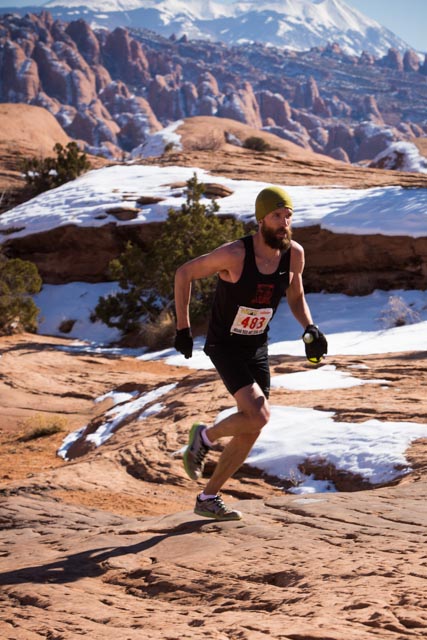
Fresh off a DNF at the JFK 50-miler, it looks as though Krar was just using that as a 41-mile training run (speedwork?) He ran at the front all day, eventually pulling away from Cameron Clayton and Chris Vargo on that last climb out of Tennessee Valley at mile 44. This was Krar’s second big “money” win of the year, and after a second place finish at Western States (his first 100-miler), wins at Zane Grey, UROC and here at the TNF Championship pretty much cements him as my pick for Mountain / Ultra / Trail Runner of the Year for 2013.

Ladies

Emelie Forsberg, Transvulcania (8:13)

Like I said earlier, Transvulcania is early in the season and most of the European runners compete at a high level in Ski Mountaineering, so for Emelie to win just a few weeks off of her “other” winter sport leads me to believe that SkiMo is great training for mountain running. Anyway, huge day for Emelie here at La Palma, beating Nuria Picas over the last 6 km for the win.

Cassie Scallon, Lake Sonoma (7:47, CR)

Cassie had been leading through the first 30 miles of the race, and then she fell apart. Literally, being passed by Joelle Vaught and going down 3 minutes by mile 38, Cassie somehow pulled it together and overtook Joelle for the win and course record. On a deceptively hot day and on a deceptively relentless course, Scallon showed a ton of grit and determination to go for the win.
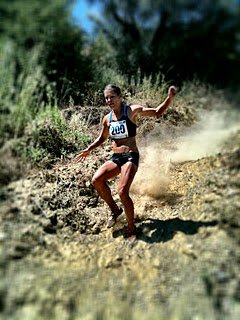
Michele Yates, TNF Championship (7:21)

Another superb finish for someone that wasn’t on anyone’s radar at the start of ’13. Yates systematically destroyed the field at TNF, the most competitive 50 of the year. It places the added demand on all runners to have something left over this late in the season, and for Yates to be able to go out super aggressively and never relinquish the lead for the entirety of the race says something about her drive. A great finish to the season, and another reason why I’m naming Yates as my female Mountain / Ultra / Trail Runner of the Year for ’13.

50k Performance of the Year

Dudes

Sage Canaday, Speedgoat (5:08; CR)

Probably the hardest 50 km race in the states (in terms of altitude & elevation) Sage showed dominance from the get go, breaking Max King on the first huge climb while stretching out a 9-minute lead by mile 21. Holding off a late surge from Anton Krupicka, (nice to see that dude back racing) Canaday wins against a super competitive field over names like Jason Schlarb, Luke Nelson and Timmy Olson.

David Laney, Chuckanut (3:40, CR)

In his first ultra attempt, Laney breaks Geoff Roes’s course record, outlasts Max King and a tough field to win the Pacific Northwest’s toughest 50k. With his win at Waldo, Laney is quickly making a name for himself- two ultras, two wins, two course records. He’s the guy to watch in 2014, without a doubt.

Max King, Way Too Cool (3:08, CR)

It seems like Max was always finishing 2nd or 3rd this year, and after a dominant 2012 he sort of (kind of) takes a step back. Not to worry, he dominated the W2C race this year, another early season warm-up race held in Cool, California on parts of the Western States trail. Running against an insanely stacked field, King showed mettle early and broke away from Leor Pantilat and Chris Vargo for the dominant win.

Ladies

Stephanie Howe, Gorge Waterfalls (3:49)

There’s the “other” awesome Pacific Northwest 50 km race, Gorge Waterfalls; which showed off Stephanie Howe’s complete dominance in back-to-back years, setting another course record in the meantime. Winning by 16 minutes over Catrin Jones on some of the most beautifully scenic and rugged trails is no small feat.

Meghan Arbogast, Way Too Cool (4:06)

Meghan had to fend off a surging Rory Bosio to win one of the most competitive 50 km races in the States. Never mind that Arbogast is still a beast at 51 years young, beating women half her age, she showed a ton of poise and determination. It’s truly inspiring, and besting such a stacked field also proves that you can still run it fast into your fifth decade.

Stephanie Howe, Speedgoat (6:17)

Another win at the 50 km distance for Howe, who passed Jodee Adams-Moore in the final downhill to win by about a minute. Adams-Moore ran in first the whole race and Howe’s patience and determination got her the win.

Jodee Adams-Moore, Chuckanut (4:01, CR)

This time it was Adams-Moore’s turn, beating a tough field of Devon Yanko, Cassie Scallon and Kerrie Bruxvoort. She takes the course record down a full 8 minutes and wins over Yanko by 21 minutes. Pretty dominant stuff out there.

The Winners!

After reading all the nominees above, I’ll now present you the winning performances.
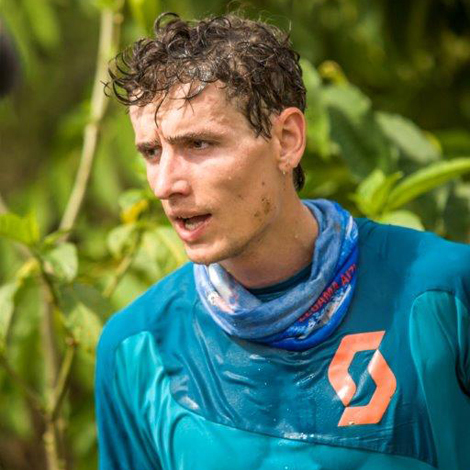
100 Miles (Men): it’s gotta be Ian Sharman‘s Grand Slam record. To do that amount of mileage and winning in all of 10 weeks, that’s amazing. 4th at States, 4th at Vermont, winning at Leadville and a 2nd at Wasatch is pretty unbelievable. He was pushed along by Nick Clark, who was doing the Slam “bandit” style (not officially registered, but whatever) who also came in under the old record.

100 Miles (Women): Rory Bosio‘s complete obliteration of UTMB. Nothing else really comes close.
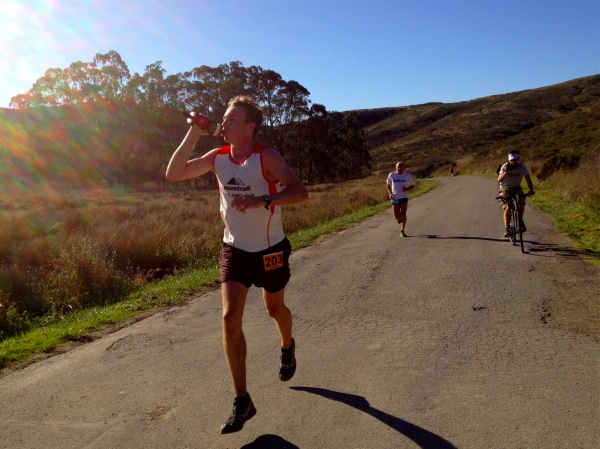
50 Miles (Men): gonna have to go with Dakota Jones‘s annihilation of Matt Carpenter’s CR at Solstice. He didn’t run against crazy good competition but to go out and blow up a Carpenter CR is just amazing.

50 Miles (Women): Michele Yates‘s wire-to-wire win at TNF was as dominating a performance this year as I’ll see, and to do it against the most stacked field? Gotta give it to her.

50 k (Men): Sage Canaday, Speedgoat. Sage wins the first climb, lights out after. Sage had some huge wins in the early season and faded a bit late, but he’s my early pick for MUTROY ’14. Watch Sage- there’s some murmurs going around that he’s hungry…
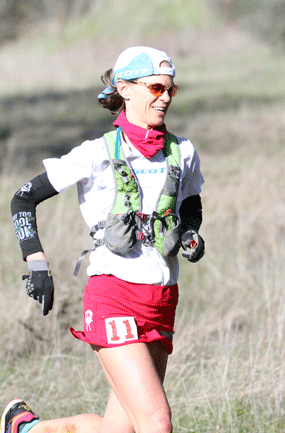
50 k (Women): Meghan Arbogast‘s win at Way Too Cool is too storybook not to give her the award. I won’t go in to too much detail, but read this article for more on her story.

I guess you already saw my MUTROYs above, Yates and Krar. That was pretty easy, they deserve those awards.

Now for the Rookie MUTROYs (first ultra in the calendar year of 2013):
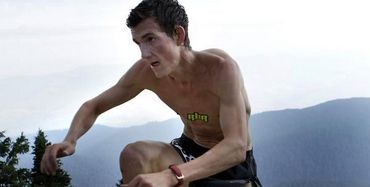
Men: David Laney. A win at the 50 km distance (Chuckanut) and the 100 km distance (Waldo) cements this fact, and he’s the #1 guy to watch going into next year. He just ran a 2:18 at California International Marathon so he’s got that Max and Sage kind of leg speed; I’m just saying “look out” for this dude.
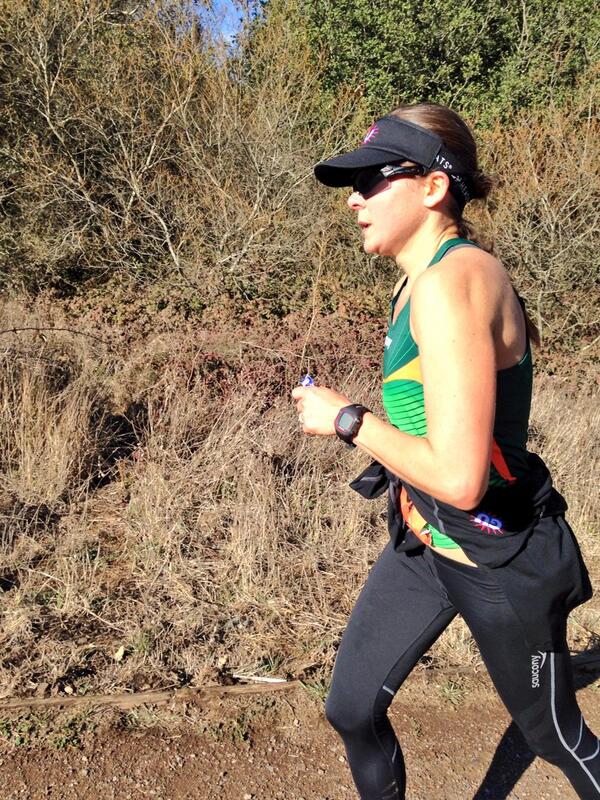
bouletWomen: Magdalena Boulet. This was a tough choice, not because the female rookie competition was so tight, it was because there was such a lack of first year ultra talent to choose from. But this former Olympian (with a 2:26 road marathon to her credit) blew away everyone (except Runner of the Year Michele Yates) at TNF Championships. She’s running W2C in ’14, so stay tuned.

Runners to watch for 2014…

Men:

Chris Vargo– dude is a monster, and he (among several other great “new” runners) made his ultra debut at the 2012 Bootlegger 50k. Here’s his 2013 stats: 2nd at W2C, 6th at Lake Sonoma, 1st (and CR) at the Golden Gate Dirty Thirty 50k and 3rd at TNF Championships.

David Laney– he’s my ’13 rookie of the year, I see him only improving. Crazy fast, hopefully we’ll see more of him in the next 12 months.

Sage Canaday– only being sick could slow Sage down this year, as he DNS’d at TNF Championships due to the flu. He was one of my picks to win the thing (as was Dakota, also felled by the flu) and I’m saying it now: Sage is my early pick for MUTROY ’14.

Alex Varner– this guy is ridiculously fast, and he just made the jump to ultras, winning both (Tamalpa Headlands 50k & Bootlegger) and setting CRs along the way. Bay Area folks know him as “the guy that wins the Dipsea and the Woodminster every year” but soon the ultra world will know him, too.

Geoff Roes– I don’t know if Geoff’s signed up for anything yet in ’14, but I hear he’s running again and looking to get competitive. I’m hoping he’s going to be at or near the level he was when he was last competing; but if not, his presence is still awesome for the sport.

Women:

Emily Harrison– Emily finished 2nd at the 2012 JFK50, her first ultra ever. She then went on to the Moab Red Hot 55k, the Mormon Fat Ass 50-miler abnd finish 7th at Western States, her 100-mile debut. Those impressive races were then followed up by a 2nd at Bootlegger 50k and a win 1at JFK50 this year.

Obviously Magda Boulet (see above).

Stephanie Howe– she’s making her 100 mile debut at the ’14 WS100, and I’m sure she’s going to podium there. With a super strong showing at last year’s UROC 100k and a several top-3 finishes at the 50-mile distance I’m sure she’s ready to crush it in 2014.

Anna Frost and Ellie Greenwood; both were injured for most of 2013, so I’m looking for those two to bounce back big time. Ellie is signed up for Lake Sonoma, and hopefully Anna is running back at full strength as well.

Races to watch:

Lake Sonoma 50 (April 12th): Rob Krar will be there this time to take on defending champ Sage; along with perennial beasts Max King, Dave Mackey, Jason Schlarb, Nick Clark, Chris Vargo, Ian Sharman, Timmy Olson, Joe Uhan, Jorge Maravila, et. al. Possibly another CR? Should be awesome, I’ll be running about 3 hours behind these guys.

Western States (June 28th): always a stacked field here, except for the returning champ Timmy Olson (he’s focusing on Hardrock). And the women’s field is pretty unbelievable- Nikki Kimball, Aliza Lapierre, Emily Harrison, Stephanie Howe, Amy Sproston, returning champ Pam Smith, Meghan Arbogast, wow- that’s going to be a great race. But look at the top guys: Krar, Miguel Heras, Mike Morton, Karl Meltzer, Jez Bragg, Nick Clark, Dylan Bowman and Ian Sharman. I think Rob Krar gets his first big 100-mile win, but I’m also picking Dylan Bowman and Nick Clark to podium. I’ll change these picks as we get closer, but for now…

Hardrock (July 11th): This race was made for Kilian Jornet’s style of running. I’m calling it now; Kyle Skaggs’ old CR is going down. Also; Julien Chorier, Dakota Jones, Timmy Olson, Joe Grant, Nick Coury, Tim Long, Jared Campbell… Crazy good field, and will make everyone sort of forget about that race from Squaw to Auburn two weeks before.

There it is, the 2013 Mountain / Ultra / Trail Running Year in Review from where I’m sitting…
Posted in Uncategorized | Tagged , , , , , , , , , , , , , , , , , , , , , , , , , , , , , , , , , , , , , , , , , , , | Leave a comment

2014 Miwok! F**k Yeah!

Super psyched to be picked in the lottery for the 2014 Miwok 100k up in Marin. This is going to be about 12 more miles than I’ve ever done and about 2,000 more feet of vert than I’ve ever encountered.

Here’s a really cool video from 2012, which was the first year of the new course (last year was only a 60k because of a fire):

Training starts next week. If I get into the San Diego 100, I guess I’ll be using Miwok as my last long training run.

If not, I guess I’ll just race it and figure out another race to do as my first 100.

Posted in Epic Runs | Tagged , , , , , , , , , | Leave a comment

The North Face Endurance Challenge 50 Mile Race Report

There was a split second upon waking at 3:00 AM Saturday morning when the fleeting notion flashed through my thoughts that I might not be able to race today…

But having trained so hard this past year, not to mention the amount of vitamin C and precautionary herbs and medicine I took last week to not get sick (everyone around me had something) my ego wouldn’t let me stay in bed.

After all, the very idea of endurance sports is having to overcome more than a few obstacles; so waking up with a little tickle in the back of my throat and an encroaching sinus headache (as I now write this I’m fully sick with a gnarly cold, also sore as all hell from the waist down) and with an impending two week hiatus from training (read: I’m still running, but with no focused or scheduled workouts like tempo runs or hills, etc.) I figured I’d go for it, maybe blow up in fantastic fashion, whatever.

Only a fractured bone or torn ligament could keep me from running, and it would have to be somewhere in the lower half of my body (I’d probably still try to give it a go with a broken scapula).

First off, in terms of race organization, The North Face’s staff at the check-in tent was top notch; they got my drop bags tagged and stashed, got me all ready to go inside of 3 minutes. I located a Porta-Potty (there were about 50 lined up only 25 yards from the Start/Finish line, that’s awesome), took care of some business and made it to my start wave just in time (I missed the Elite Wave 1 and Wave 2 starts). But when nature calls it’s best to answer.

I felt really good early on, in fact; I felt great until about mile 20 or so- right on that damn exposed single-track out-and-back section between Pantoll & McKinnon Gulch aid station. The constant starting and stopping (we were instructed to yield to the runners coming back from the aid station) plus the insane headwind made me absolutely miserable. Adding into the equation both the icy patches all over this section of trail AND that damn hip pain that seems to show up later in races for me (usually around mile 25-27) and I was now re-evaluating my goal of a sub-9 hour finish.

It was really cool to see some of the elite field at this point- I missed that first lead pack of fast dudes: Rob Krar, Cameron Clayton, Chris Vargo, Jorge Maravilla, Max King, Adam Campbell, Dylan Bowman, Rickey Gates, Dave Mackey, et. al. but started seeing a few familiar faces like Emelie Forsberg, Joelle Vaught, Anna Frost and Rory Bosio (who I found out dropped from the race at some point). I also missed the first pack of elite women: Michelle Yates, Megan Kimmel and Cassie Scallon.

I also saw Dakota Jones about 3 minutes out from the aid station, looking pretty haggard. Here was the guy I thought was going to win it all having a really tough day (I learned later he had the flu but still toughed it out, finishing in 9:40). I’ve heard some of the top runners say that the true heroes of the race are the folks out there for 13 or 14 hours, finishing towards the back, trying to stay ahead of the cut-offs; that takes some serious guts to stick it out like that. Dakota, who’s used to finishing in the top 10 of almost every race he enters, had a performance that was truly inspiring.

My attitude was probably going south at this point in the race because I was getting low on calories so I loaded up on salty potatoes at the aid’s buffet table and was able to catch up to the 4 or 5 runners (on that next big downhill to Stinson Beach) that passed me as I lingered at McKinnon Gulch. Then I picked up my pacer, Jimmy, who was in high spirits and attempted to lift mine. 

That climb up to Cardiac AS was probably the worst I felt all race. That was unbelievable. As I hit the aid station (and my drop bag) I was able to get some substantial calories in me in the form of Vitargo as well as shed my jacket. The drop into Muir Woods was pretty uneventful, I picked up some steam as we descended but didn’t truly feel better until the climb out of the canyon on Lost Trail. For some reason that long uphill of power hiking got me back in the game and I was able to run really well (with a lot of complaining) until the Old Inn AS at mile 36.

Then that little climb up from the creek that runs behind the Muir Woods parking lot tore me up. I rolled my ankle on the descent (minor roll, mind you) and was able to somewhat hammer it down to Redwood Creek. That flat section was welcomed, but the best I could manage at this point was a shuffle somewhere between 10 and 11 minute mile pace.

Muir Beach AS came and went, ate some Shot Bloks and some potato chips there, got some electrolytes and began the climb up Coastal Trail and then Coyote Ridge. I was able to do that “run a minute, walk two minutes” thing all the way up that climb until Miwok, where it became at first a mellow, then a steep downhill all the way to Tennessee Valley AS.

This was the second worst I felt all race- I had this sharp stabbing pain right behind the ball of my left foot that hurt with every stride. Never had that happen before, but that reduced me to that 10-minute shuffle. We happened upon some overly chatty guy with IT band issues that was all, “mind if I death march with you until the aid station?” No dice, bruh- If I can walk I can run, and you just gave me the motivation to run the F away from you.

Tennessee Valley, mile 44; more quality calories waiting for me in my drop bag, a couple little cups of Mountain Dew (caffeine has a nice effect this late in the race) and some salty potatoes and we were off. I was able to get a nice run going up the Marincello Trail, which for the uninitiated is a long, mellow uphill. Switching from quads to calves right now was the best thing ever. We walked a minute with some marathon runners, they were pretty funny. On to Bobcat Trail, then Alta- I was running again. Oh, it hurt like hell, but I was moving well once again.

On to the Alta AS, mile 46.9- I could smell the finish. Two more cups of Mountain Dew, then a long downhill on the Rodeo Valley Trail and it’s all over.  I looked over at Jimmy and said, “let’s go catch that guy in the yellow” and after we passed him like he was standing still, we went into “hunt” mode. This is when I try to pick up as much carnage as I can on the way to the finish, I imagine myself as a tidal wave destroying everything in its path.

We were moving at about 7-min pace, passing about 10, 15, maybe 20 runners right here- I couldn’t tell if they were 50-milers, 50k or marathon runners, but I smelled blood and it was on. I looked over at Jimmy, stifling tears from the immense pain I was in and with as much as I could muster asked his permission to put my headphones on. Music would kill the pain.

Once we got to the bottom and hit the road crossing I looked back and saw a runner with an orange bib, denoting he was a 50-miler. Oh, hell no I thought. I turned it on again up that little paved section. It’s less than a mile now and if I can just hold this meager 8:45 pace then this guy isn’t gonna get me.

Once we were in the clear, I gave Jimmy a high five (or a fist bump? I was dazed, yo) and crossed the finish line to a smattering of cheers. As a medal was placed around my neck, I looked around and saw all the people eating, drinking, laughing. Most had medals around their necks, too.

9:41:22 / 101st place (81st men, 19th men’s 35-39) / 11:38 per mile

(Official results here, enter bib #493)

Garmin Stats

All in all, it was a really great race, having to overcome the cold, wind and ice. I made some mistakes with nutrition, probably could’ve wore tights, an extra pair of gloves would’ve been nice, etc. but in these type of long trail races the ability to endure is what it’s all about.

And to be reminded once again that what’s going on outside has little to no bearing on what’s going on inside.

Posted in Race Reports | Tagged , , , , , , | 2 Comments

What I Learned Trying to Set an FKT

I spent six hours running alone yesterday, trying to set an FKT on the East Bay Skyline National Trail. I did it for several reasons, the biggest was to just get that trail on the map; of all the long trails in the area, it’s by far my favorite- it varies from wide fire road to paved sections, to single-track, to shaded rooty and rocky segments around redwoods, past eucalyptus groves, traversing canyons, through meadows, along ridge tops and down into valleys. This first reason falls into the category of “the greater good”.

The second was to have my name sit at the top of the leader board for a few days, weeks or months; maybe brag a little, also have my name connected with said trail. When I think of the Grand Canyon’s Rim-to-Rim-to-Rim (R2R2R) trail’s fastest known times and how that has been lowered, I would explain the lineage like this: Kyle Skaggs‘ 7:37 in 2006, then Dave Mackey‘s 6:59:56 in ’07, then Dakota Jones‘ 6:53:38 in ’11 breaking that, then finally this past May Rob Krar with a 6:21:47. I mean, c’mon- how many people can say “yeah I set an FKT on a trail”? I can claim that for a little while, hell- I might try to break my own record on fresh legs sometime in the near future. So for that reason, the latter falls into the “ego stroking” category.

So how does one reconcile two opposing perspectives? The outside-in aspect of “the greater good” with the selfish, inside-out angle of “ego stroking”?

Somewhere during the run I had to change my mind; I had to first alter my goal of running around 5:15. To run at or near “race pace” when not in a race is really, really hard to do. Gone is my sense of being hunted (or being the “hunter”); these are the two modes I switch into during the second half of a race- if I feel good, I’m out hunting for carnage (those runners just trying to maintain some sort of shuffle to the finish; basically falling apart in the last few miles) or if I’m in their shoes I’m constantly looking over my shoulder, trying to well, “maintain a shuffle to the finish and basically falling apart” to quote myself there. I just didn’t have either yesterday. And that is certainly an ego-deflating endeavor, the idea of slogging to the finish.

There were definitely some points during the run when I was saying to myself “this just isn’t fun right now” or “25 miles is more than enough for a good training run, let’s just call for a ride home now” or “that rock looks just like a pillow, I could lay down and take a quick nap” or “why am I doing this?” At mile 22 I was in a fair amount of pain and even music couldn’t pull me up out of it, music always works. Where was all that gusto I had the first 8 miles? I had a solid nutrition plan, I was taking in calories, was drinking the requisite 20 ounces of water per hour; the weather was perfect, what was going on? Was it the 1,880 miles already logged this year? No, my legs are well-trained for the 50k distance. Oh, right- the other thing. My mind.

It can be said that endurance sports and what goes into training for them is largely mental, meaning that you have to also train the mind. My logic goes like this: anyone can run a marathon, that’s all fitness. But a 50-miler? Fitness will get you the first 25 miles, the next 25 are all mental. So what mental states are we talking about then? Well, there’s the idea of being comfortable with being uncomfortable, sometimes for many hours. Disassociating from pain while associating with your body. Keeping a Zen-like focus on your breathing, arm swing, stride rate and gait, landing on the mid-foot, etc.

It got me thinking: my mind is trained to race. Is my mind trained to train?

For me, eliminating competition has a neutral effect on my running. I’m just too competitive to race against myself or my expectations without the framework of a race or a solid, set goal. I’ve raced against my own times and “won” on shorter Strava segments and had plans during races with preconceived split times that I could hit; all the things that would tell me that my mind is trained. But maybe not when the grand scheme involves me being the first to do something. Hence, running near 11:20 per mile yesterday instead of the ~10 per goal I had set in my mind.

I feel as though now the bar has been set (albeit super low) I can run against that time of 6:00:09, and in a community sense that’s a pretty easy time to beat. I want that time to be beat; I’d love for someone to go out next weekend and take an hour or two off that time. Here’s my actual post on the FKT Proboards site:

I set the initial self-supported FKT on the East Bay Skyline National Trail today with a time of 6 hours, 00 minutes and 9.52 seconds.

Garmin stats: connect.garmin.com/activity/405047984#

Strava stats: www.strava.com/activities/95484818

I had a really rough go of it; seeing as I didn’t really taper I was woefully under-prepared. I more-or-less treated this as a long training run in lieu of running a 50k today in preparation for The North Face Endurance Challenge 50-miler in Marin on Dec. 7th, and having done a 24-miler and a 12-miler back-to-back last weekend I just didn’t have the legs to really push the pace.

That being said, have at it! I’m probably going to attempt this again in January (hopefully after a rain fall; I would bring my Sawyer filtration device and go at it unsupported). I’m also thinking of eventually doing a south-to-north run on this trail and a yo-yo (63-ish miles).

I love this trail and hope to see the record lowered to around 4 hours; there’s a lot of really great long trail runners in the Bay Area that could demolish my time.

I set the bar nice and low.

The unselfish part of me is thinking: yeah, good job Jimmy- you posted your unimpressive FKT and are inviting people to go break it, contributing to the trail running community and therefore “the greater good”.

Then there’s the selfish version of me thinking: damn, I’ve got to get back out there and break it myself, for a little more “ego stroking”.

Either way, I learned a lot yesterday about how I think about things out there on the trail. The desire to finish became the most important thing in my mind- finishing something you start can be the most rewarding thing in and of itself, no matter how long it takes.

It’s been said that the last person to finish a race had so much more to overcome than the winner, and I can get behind that. If everything yesterday went totally according to plan, I wouldn’t have learned all these things about myself and wouldn’t have the opportunity to make improvements to be a better runner and ultimately a better human.

Then the whole thing would have been a terrible waste of time.

Posted in Epic Runs | Tagged , , , , , , , | 1 Comment

FKTs Are So Hot Right Now!

I’ve been wanting to get out and do a full run (all 32+ miles) on the East Bay Skyline National Trail for a while now, so consider this my “intent to attempt” said trail. There’s no known FKT (fastest known time for those of you that are new to adventure/long trail running) so I’ve decided to forgo a 50k race as my last long training run for The North Face 50-miler on December 7th and instead get out and do a self-supported run on my favorite long trail in the East Bay.

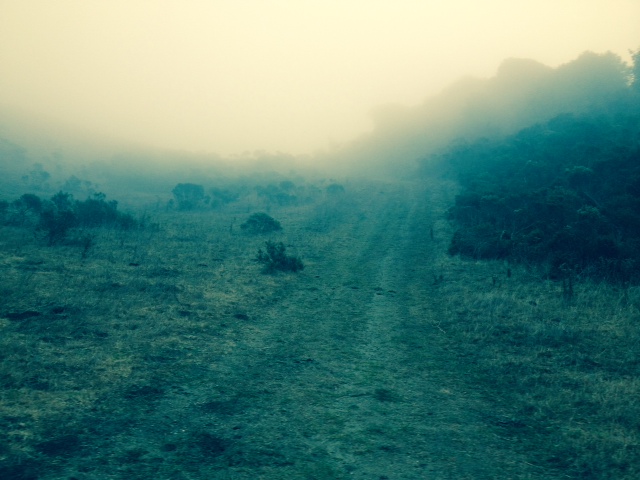
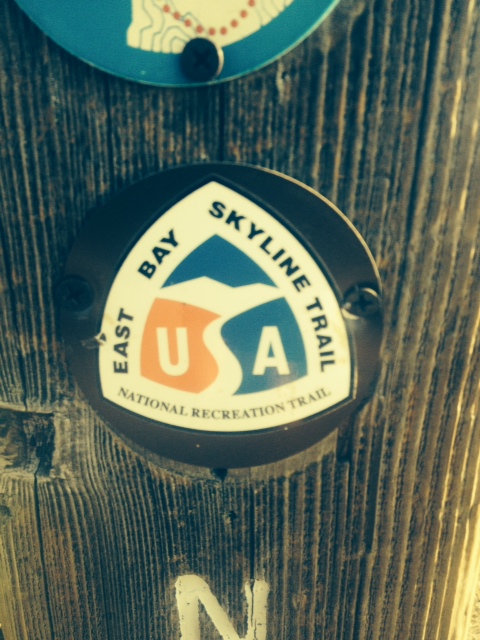
I did a little 6 miles out, 6 miles back on the beginning portion today and there’s a ton of climbing involved. Here’s a few pics:

image_3 image_1 image_2Anyway, here’s my post on the FKT Proboards site: EBSNT FKT attempt

If you don’t want to link out to that, here it is in full:

Hi, my name is Jim McCaffrey and this upcoming Saturday, November 16th, 2013, my plan is to try to set a self-supported East Bay Skyline National Trail FKT. The trail traverses the ridge line above the coastal mountains situated to the east of Richmond, Berkeley and Oakland; and ends in Castro Valley. It goes entirely through the East Bay Regional Park system; Wildcat Canyon, Tilden, Sibley, Huckleberry, Redwood and the two Chabot parks. This is the eastern portion of the yet-to-be-completed Bay Area Ridge Trail.

My plan is to start around sunrise (~6:30 AM) at the northern terminus (Wildcat Canyon Staging Area in Wildcat Canyon Regional Park, on Park Ave in Richmond, CA) where there’s a short paved road that ends at the Wildcat Creek Trailhead and run/hike south. I will be carrying all of my nutrition from the start and will be using water sources along the way (there are three sources available; the first at Tilden Steam Trains, the second at Sibley Staging Area and the last at Skyline Gate). I believe that since these aren’t “natural” sources this run can’t be considered an unsupported attempt.

There will be no outside assistance of any kind, except of course a ride to the start from my partner Allyson Hurlburt and then a ride home from the finish (Proctor Gate Staging Area in Lake Chabot Regional Park, on Redwood Road in Castro Valley).

I will also be using the French Trail portion of the route through Redwood Regional Park; I believe it’s marked so that hikers can use either the French Trail route or the West Ridge route. I however think that the up-and-down of the French trail (the “crown jewel” of East Bay trails, imho) along with its beautiful single-track (as well as being closed to bikes) adds some challenge to the 32+ miles.

I will use my Garmin 310XT to GPS my entire run and will use both Instagram (@therealjimmymac) and Twitter updates from @jimmy76mac every 5-7 miles as AT&T 4G service allows (I think I’ll have a connection for the duration of the run and this will allow tracking in real time.)

Trails used and mileages:
Wildcat Creek .44 to Belgum
Belgum 1.00 to San Pablo Ridge
San Pablo Ridge 1.28 to Nimitz Way
Nimitz Way 4.72 to Curran
Curran .27 to Sea View
Sea View 2.18 to Vollmer Peak
Vollmer Peak ~.55 to Lomas Cantadas (water)
Lomas Cantadas 2.55 to Old Tunnel Staging Area

OTSA .87 to Sibley Staging Area (water)
Sibley SA 2.76 to East Ridge
East Ridge .20 to Skyline Gate (water)
Skyline Gate .56 to French Trail (via West Ridge)
French Trail 4.04 to Orchard
Orchard .18 to West Ridge
West Ridge .62 to Golden Spike
Golden Spike .78 to Big Bear Staging Area
BBSA .25 to MacDonald
MacDonald 2.52 to Grass Valley
Grass Valley 1.48 to Brandon
Brandon 5.36 to Proctor Staging Area
Approximate distance: 32.61 miles

I’ve only been able to find available info from a few thru-hikers through their websites; here’s one: http://gurmeet.net/hiking/hikes/East_Bay_Skyline_National_Recreation_Trail.html

I feel this trail is an under-rated, yet iconic gem of the East Bay (and Northern coastal California for that matter); both the Dick Collins Firetrails 50-miler and the Skyline 50k are two classic East Bay races that both use large (southern) portions of the trail. 

So there you go. Tune in next Saturday via Facebook / Twitter / Instagram. I’m hoping to do the whole run in about 5.5 hours, give or take 30 minutes.

I also know there’s some really good runners in the Bay Area that could probably do this run in 3:45-ish time, and that’s what I’m hoping- I’m merely setting the first FKT so that someone goes out and breaks it. Then, someone goes out and breaks that.

Then, someone breaks that. On and on ad infinitum.

Posted in Epic Runs | Tagged , , , , , , , , | 1 Comment

Optimized Fat Metabolism – To Carb or Not to Carb

Part 2: You Are Going to Hit the Wall…

…unless you build a bonk-proof body. Ah, the bonk. The dreaded “wall” that is coming (for you marathoners it’s at about mile 20-22) and is basically the term for running out of energy. But don’t fear! You can stave off the wall by applying a few of these tricks, but first let’s talk about carbohydrates and energy.

Quick biology lesson: the body utilizes three macronutrients to power your muscles; carbs, fats and proteins. Enzymes then convert those into adenosine triphosphate (ATP), which basically transports chemical energy within cells for metabolism.

Carbs are stored in our muscles and liver in the form of glycogen. For super high intensity (think: sprinting) down to medium intensity (tempo training runs) carbs are the fastest and most accessible fuel source; here’s the downside though- your muscles have no choice but to start burning glucose in the absence of oxygen (anaerobic metabolism) which causes the dreaded by-product lactic acid (that’s the burn in your muscles). As all that lactic acid continues to build up in your muscles and blood they inactivate the enzymes that govern glucose metabolism causing you to do one of two things: slow down OR bonk.

So the average human body, with its 2,000 calorie supply of glycogen is ready to do about 2 hours of really hard running OR it can slow down a little bit and learn how to switch itself over to fat metabolism. Fat provides a much bigger ATP return and is by far our most plentiful fuel supply, with more than enough energy already in and on our bodies to power us along through a 100-mile race, a full Ironman or a double century bike ride. Since fat is burned in a carbohydrate oven, small concentrated sources of carbs are needed to kick-start the metabolizing of fatty acids.

Okay, after all that science we can get down to brass tacks. To carb or not to carb, that is the question.

You already know my answer, and it’s based partially off the following experience…

I ran some shorter trail races in the past year (a 7-miler, a 9.2 mile race and a 27k) and for all three of these, I did use primarily carbs before and during these activities. The pace I ran for the 2 short ones were definitely both at the upper end of my aerobic threshold. I went all out on those (and had some left in the tank after) because they were pretty short runs and I knew I could hammer it the whole way.

The 27k race had about 3,500 feet of climbing and I raced using a combination of anaerobic sprinting (feel the burn!) and was at the upper end of my aerobic capacity for the duration of said race. I narrowly avoided a bonk (only because cramping was a bigger issue and that issue forced me to slow down; but I felt woozy and strange and I’m sure that was an impending bonk) because I did two things wrong; started off at an unsustainable pace AND underestimated that I’d need to burn more fat- I had carbo loaded the days leading up to that race and didn’t rely as heavily on my fat stores as I did in say a marathon or a 50k. I should’ve treated treated this race like an ultra.

Let’s look a little deeper, then. Why in a 16.8 mile race did I almost bonk when I’ve never even come close to bonking in a 50-miler or a 50k? What was at play in my body that day?

I think a few things jump out; one- I had switched my body out of fat-burning mode (or nutritional ketosis; more on that later) and into a glucose dependent state; I’ve already discovered that I’m pretty insulin resistant (self-diagnosed, but all of the significant physical markers were there: Insulin resistance- Signs and Symptoms) so I may have “overdosed” on the sugars. Two- I had more or less felt absolutely physically great since early March when my body became fat-adapted to running aerobically. In the 2 days prior to this race, and I’m blaming the sugar here, I had some mood swings, slept shitty and generally was hungry the whole time.

Says Peter Defty of Vespa:

“When you do the math regarding fasting blood sugar in a human, this works out to amount to 1 teaspoon of sugar, as glucose in circulation, [just] one teaspoon! This is normal and this is where your body prefers your glucose levels to be. Blood sugar is VERY tightly regulated. So, say someone eats a whole wheat bagel. Basically they just dumped 8 to 10 teaspoons of glucose into their blood stream when the body likes to have [just] 1 teaspoon. The body deals with this by secreting insulin so this toxic level of glucose can get back down to fasting levels and do so quickly.

But, just as importantly, to help promote glucose use high levels of insulin suppress [both] fat burn via beta-oxidation in the cells and the production and use of ketone bodies for brain and nervous system function. On the receptor sites of adipose (fat) tissue insulin functions to promote fat storage and strongly inhibits the release of fat. These are the immediate “unintended consequences” of concentrated carbohydrate consumption. There are many other possible “unintended consequences” that can crop up over time like intestinal issues, insulin resistance, weight gain, energy swings, heart disease, cancer, non-alcoholic fatty liver disease, metabolic syndrome, etc.”

Basically, I wrecked my body for that day and wasn’t able to race it like I could, my body was storing fat instead of releasing as energy like I had taught it to the months prior. Since I’m happy with my placement and time in that race and was using it as a training run for the Skyline 50k I’m glad I learned what not to do (as in: DON’T DEVIATE FROM THE PLAN 2 DAYS BEFORE A RACE). I still couldn’t help feeling at the end of that race that something just wasn’t right. It took a few days of proper eating to get my body back to feeling okay, and besides all the soreness (I usually don’t have that much muscle fatigue and/or soreness, even after a 50-miler) my stomach was kind of destroyed as well.

So there you go. I’ve learned what works for me as an endurance athlete. What works for you?

Sources:

Will from An Ultra Runner’s Blog “Burn Fat for Fuel? An Interview with Peter Defty of Vespa Power”

Ian Torrence “Your Ultra-Training bag of Tricks: Unbonk!”

Sara Latta “Hitting the Wall” Sept/Oct 2003 issue of Marathon & Beyond magazine

Posted in Nutrition | Tagged , , , | Leave a comment

Optimized Fat Metabolism – A Primer

Part 1: My Experience

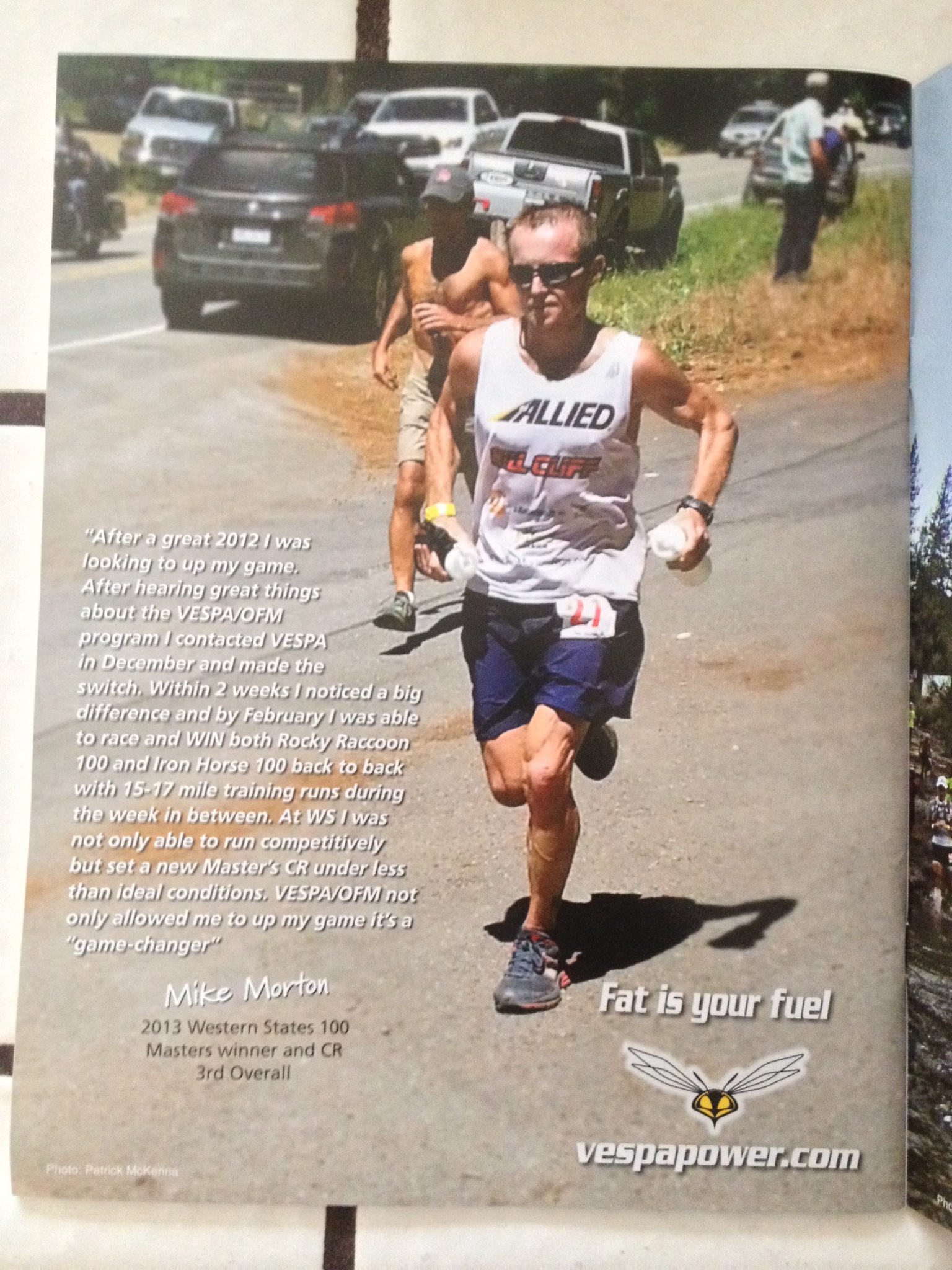
I’m sure you’ve all seen the ads in UltraRunning or TrailRunner Magazine, the one that goes “Fat is your fuel” with a pic of an outrageously fit runner powering up a trail and a testimonial about how they’re running better on less calories, or got leaner and faster since switching to a low carb or OFM (optimized fat metabolism) diet. Yes, you’ve seen it. Have you wondered about it?

Here’s one from the August ’13 issue of UR: mortonI was having a lot of gut problems this time last year- it seemed that every long training run or race involved an unscheduled pit stop, so much so that I resorted to bringing TP in a ziploc bag on these runs. I started to think, “there’s got to be a better way”. I tried Immodium before runs, I tried no fiber 24 hours before, I tried a lot of things that just didn’t work.

People also noticed the mileage I was running and the fact that I still had that little belly bulge. “How can you run 2100 miles in 12 months and still carry all that fat?” one person actually said to me. After a particularly over-indulgent 2012 holiday season (I was hitting the baguettes, cake and pie pretty hard, y’all!) I said enough’s enough.

I was having a cup of coffee one day at the local Peet’s and up walks my friend Eric who I hadn’t seen in about 4 months. He’s always been a big guy, so I was shocked when I saw him looking insanely svelte. Long story short; he told me that he’s lost about 80 lbs (EIGHTY!) in the last 8 months on this low carb-high fat (LCHF) diet.

The Vespa ads flashed in my brain, as did the Phil Maffetone podcast I had listened to recently. It felt as if everything was coalescing into a master plan to get me to start utilizing fats as a fuel source. I was witnessing it in person that it could work. I had already started buying into the idea that my stomach problems were possibly related to wheat and gluten (seems like everybody’s hatin’ on gluten these days) so I was ready to try something.

Goodbye grains. Bye-bye bread. Later, tortillas. So long, sugar. Sayonara rice and pasta. Potatoes? Aw, man- I love you but I have to say bye. I cut out all starches, processed carbs & sugars immediately. I cut out all high glycemic fruits (bananas, pineapple, mango) and stuck to berries.

I started a love affair with previously under-appreciated items like full fat Greek yogurt, heavy whipping cream, butter, coconut oil, nut butters (sunflower seed & almond have become staples; all varieties of nuts for that matter). I chose grass-fed cuts of beef and free-range chicken. More buffalo. More lamb. More greens to compensate for the lack of nutrients I hadn’t been getting while on the Standard American Diet (which spells SAD, ironically!); kale, collards, spinach, chard, lettuce varieties. Flax seeds were liberally added to meals.

It took about 8 weeks of running with a heart rate monitor (something Dr. Maffetone subscribes to, more on his approach later) to keep me in that fat-burning zone. I had never run so slow or felt more awful those first few weeks; I bonked almost every single run more than 8 miles. I was so reliant on carbs for energy I had never learned to rely on my own body’s near-endless supply of fat.

I eventually learned through my own trial-and-error processes and re-tweaking of the diet to add in more carbs from fruits, varieties of potatoes, smaller portions of brown rice and quinoa that it wasn’t necessarily about the quantity (although us Americans are the worst at “portion control”) but more about quality. High quality foods in reasonable portions used more effectively around my training schedule and overall lifestyle would actually support more fat burning.

Hence, the OFM diet. It takes three main considerations into account:

1) Not only does fat become the primary aerobic energy source, but saturated fats, the most calorically dense nutritional energy source, are a key component and not the health demon they have been made out to be.

2) OFM challenges the conventional carbohydrate centric approach toward athletic performance and human health using latest in cutting edge nutritional and physiological science to help guide the on-going program.

3) OFM does NOT eliminate carbohydrates but makes “strategic” use of concentrated sources of carbohydrates. Additionally, how the athlete consumes their concentrated forms of carbs is very important to the OFM program. Through OFM, carbs are actually utilized more effectively and efficiently to yield sustainable high-level performance while minimizing oxidative stress.

– Peter Defty of Vespa (from triathlete Trish Diem’s blog)

So there you have it, my initial experiences with optimized fat metabolism and what drew me to experimenting with it. In the following blog posts (over the next month) I’ll outline and touch on a few key points, including:

– saturated fats are actually good for you

– a diet high in carbs/sugars may be inhibiting your performance

– ketones and ketone bodies are also not the demon they’re made out to be

– you can actually build yourself a bonk-proof body

Stay tuned for more posts through the coming weeks.

Posted in Nutrition | Tagged , , , , , | Leave a comment

A Trail Runner’s Manifesto…

Ironically enough, I write this on a Friday morning as I’m home sick from work. So, yeah…

I loathe the term “ultrarunner”, especially when applying it to myself. In fact, I’ve never called myself an ultrarunner and (politely) correct those that use the term towards me.

I prefer “long trail runner” and here’s why: I won’t run an ultra not on trails. I prefer trails so overwhelmingly to asphalt/concrete/tarmac that I felt the need to express this in words.

Races like Badwater hold absolutely no appeal for me. 135 miles on a road? No thanks. Even the first 19 miles of the American River 50 are done on pavement. I think there’s about 10 miles or so of the JFK 50 on roads. That’s just too many miles on a surface I do not like to run on.

6, 12 and 24-hour races done on tracks or paved loops are also out of the question- that just seems like torture to me. I have a great deal of respect for those disciplined to do these races, but I’m not into that at all.

Yes, these are ultramarathons and in doing these races you’re an ultrarunner, there’s no question there. I’m not saying it isn’t legit, I’m writing this declaration to draw the line for myself.

I’m also not saying “forever”, this is for the “right now”. Right now I won’t be signing up for any of these races. I’ve heard runners say once they had babies and spent hours training pushing a stroller (or “pram” depending on where you’re from) they got used to roads, but I’m still not used to roads. I don’t know if I ever will be.

I remember back in April, after the tragedy at the Boston Marathon how I felt about possibly running that race and being swept up in the gung-ho “can’t stop us runners!” vibe that permeated the sport (and still does). After about a month and 2 or 3 long training runs on roads I reconsidered (I think my re-thinking of that goal was the impetus for this here blog post) and had to get completely honest with myself that I do not like running on roads. Keeping the same gait with the same pace on the same terrain as I mindlessly tick off the miles past houses and buildings to me is the most boring thing possible.

Two days before the Boston Marathon I ran the Lake Sonoma 50 and probably should’ve DNF’d. That race and that course absolutely destroyed me, I never wanted to drop out so badly like I did  that day. But I persevered and came through at almost twelve-and-a-half hours. Ouch.

I also think the other attractive thing about trail running is the accessibility of elite athletes- I’ve gotten Twitter responses from both Dylan Bowman and Mike Wardian, gotten comment call backs from Timothy Olson on his blog, etc. There’s a much closer connection between the stars of this sport and us middle-of-the-pack people. I wonder if Ryan Hall or Galen Rupp are that accessible?

Anyway, this is not meant in any way to disrespect or discredit road-runners and the sport itself; some of my best friends are road racers and I have supreme respect for what they do. I probably couldn’t run a sub-3:00 marathon (and don’t have a desire to) the same way they don’t want to run a 50-miler. And let’s face it; the mental toughness required to withstand the monotony of asphalt is equal to (if not harder than) going out for a 25-mile training run on trails.

Just give me some varied terrain with plenty of animal noises, mud, creek crossings, roots, rocks, etc. and I’m all set.

Posted in Uncategorized | Tagged , , , , | 1 Comment

Western States 2015 Qualifying Standards…

…and subsequent “backlash” (although it seems like most folks are okay with the new changes) has been pretty entertaining to watch over the last 18+ hours since I’ve discovered the news.

Basically, go here for the full breakdown: Western States makes changes

Here’s a great piece on the changes as well, from a British runner named Tim Lambert: A Moment of Panic…Western States 2015

As far as “backlash” is concerned, the only real issues I’ve seen are people complaining on NorCal Ultras’ Facebook page (re: already signing up for and paying for races like the 2014 American River 50) and a little bit on the UltraList (re: there’s not a whole lot of qualifiers in the Northeast or upper Midwest).

Interesting to see how all this will play out…

Posted in Uncategorized | Tagged , , , | Leave a comment

Goal Oriented: The rest of ’13 and Beyond…

So I’ve been looking at what I’ve accomplished so far this year, and what I’d like to do moving forward for November & December as well as 2014. First off, I have to say how lucky and blessed I am to be able to run as much as I have both in racing and training, my speedy recovery times and the fact that I haven’t burned out. I credit that to becoming more and more goal-oriented as I progress as a runner. 

So for the rest of the year, the only race I’m signed up for is The North Face Endurance Challenge 50-miler in Marin on December 7th. I’m looking at a loose goal of going sub-9 hours, which I’ll reassess the week before the race according to how my training’s been. So far I feel pretty good about that goal, just having gone 9:07 at the Dick Collins Firetrails 50. Yeah, I know there’s another 2000 feet of climbing on top of what I just did in that race but my training is specifically focused for the next 1.5 months on hills, hills and more hills.

So what’s up for November? Well, I’m putting together an “assault manifesto” so to speak on a local FKT, and before I announce my intentions on the FKT-ProBoards site I’ll just hint that it’s a local, iconic trail almost 33 miles in length with probably close to 10,000 feet of climbing. Stay tuned for that, I’ll announce my official intentions around mid-November.

So that’s that for the rest of ‘13, what about 2014? Here goes (my loose list of hopeful and definite):

Goals:

run my first 100k (I’d like to run 2 before my first 100-miler)

run my first 100-miler

go back to the Lake Sonoma 50-miler and seek some redemption for last year’s epic blow-up and subsequent 12+ hour shitfest

Calendar (subject to change):

January – random 50k? maybe a FKT somewhere local?

February – 1st (Sat) Ordnance 100k, Fort Ord, Monterey

March – 15th (Sat) Marin Ultra Challenge, Rodeo Beach  (50 miles)

April – 12th (Sat) Lake Sonoma 50, Healdsburg

May – 4th (Sat) Miwok 100k, Stinson Beach

OR 17th (Sat) Born to Run Ultra 100k, Los Olivos

June – 29th (Sat) Western States 100, Squaw Valley

July – 19th (Sat) TRT 100, Carson City, NV    

September - ? Pine to Palm 100, Williams, OR

So that’s my loosely-based goal races for 2014. I hope I can stay healthy and win some of those lotteries! Here we go!

Posted in Uncategorized | Tagged , , , , , , , , | Leave a comment